WHITEBOXX / RESEARCH & ENGINEERING
Designing an AI reporting
application for client teams.
A reference architecture for recurring client reports, covering source systems, calculations, research workflows, review and delivery.
Design around the report your team needs to deliver.
A monthly client report may combine business measures, support history and external company or market data. The application needs to retain the reporting period, show the calculations and help reviewers resolve exceptions.
This reference design shows one way to extend Evidence OS into an enterprise application. It assigns responsibilities to existing systems, the platform and customer-specific software. It is a design for a custom build, rather than a finished integration.
WORKED EXAMPLE
A reference architecture for recurring reporting.
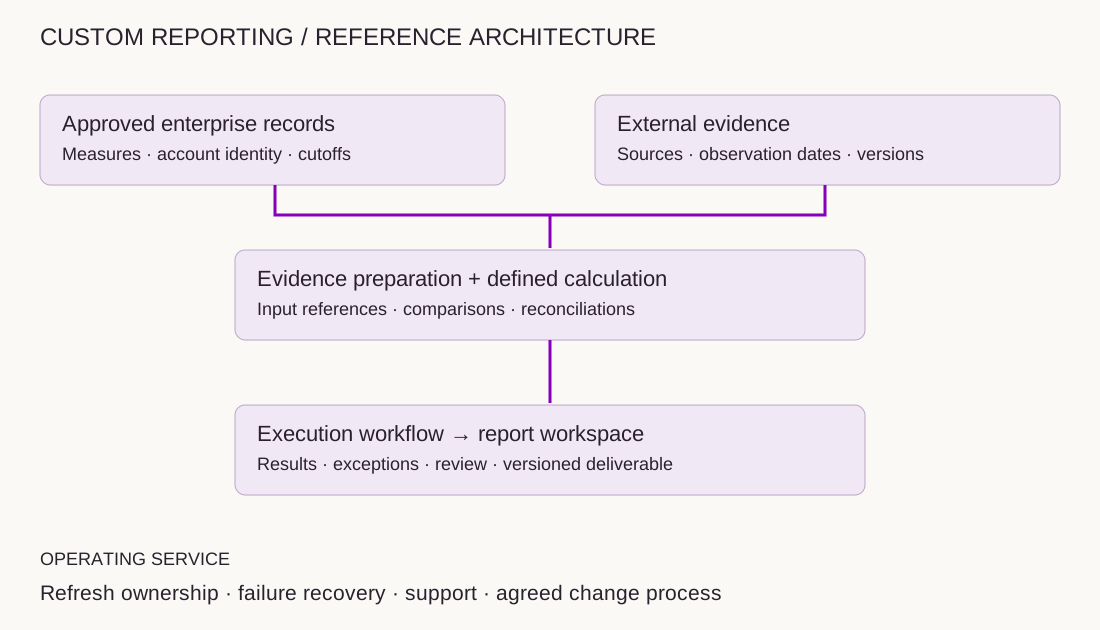
WORKING REFERENCE
Assign each part of the reporting process.
| Component | Responsibility | Working artifact |
|---|---|---|
| First-party systems / warehouse | Own the underlying business records, approved views and measure definitions. | A selected source view or extract with a cutoff and account identity. |
| Evidence preparation | Retrieve permitted external observations and documents; retain source, period and version. | An evidence bundle with source URLs, observation dates and retrieval times. |
| Analytical operation | Calculate comparisons and reconciliations at a defined grain. | A table with input references, transformation and residual or coverage checks. |
| Execution agent / workflow | Coordinate the assigned task, identify missing inputs and send results for review. | A run result and an explicit set of next steps or exceptions. |
| Reporting application | Manage the client workspace, report state, review interface and export. | A report that users can revise, approve and deliver. |
| Operating service | Maintain refreshes, diagnose failures and support changes under the agreed service. | Run history, support ownership and a change process. |
Store the calculation, explanation and report status separately.
A revenue bridge is a calculation. A suggested cause of churn is an interpretation. Approval status is part of the reporting workflow. Keeping them separate makes it easier to revise one without losing the others.
A reviewer should be able to open a finding and see its supporting table or passage and reporting period. Retain the issued report when new evidence arrives, then create a working revision for the next review.
Show what happens when sources change or fail.
A report may combine a current support extract with an annual statistic. Display the dates for both. If a required extract fails, mark the new run incomplete and keep the prior approved report accessible.
A revised source can trigger a recalculation without publishing a new client report. Define which changes need review and which should generate a notification.
Agree who owns and operates the system.
The engagement should specify where the application runs, the source code and deployment materials the customer receives, and who maintains the supporting services. Customer-owned software and a recurring Whiteboxx operating service have different responsibilities.
An architecture sprint can define users, systems, data access, deliverables, costs and acceptance checks. Evidence OS provides reusable data, agent and workflow services; custom engineering adds domain logic, application interfaces and integrations. The reporting design is one example of that extension model.
Take the architecture into a working session.
An example brief and diagram showing data flow, revision behaviour and acceptance checks.
Reporting architecture brief (Markdown) ↗Architecture diagram (SVG) ↗